Sunday, August 14, 2011

At Least I'm Not That Guy

During these hard days and hard weeks, everybody always has it bad once in a while. You know, you have a bad time of it, and you always have a friend who says "Hey man, you ain't got it that bad. Look at that guy." And you look at that guy, and he's got it worse than you. And it makes you feel better that there's somebody that's got it worse than you.  But think of the last guy. For one minute, think of the last guy. Nobody's got it worse than that guy. Nobody in the whole world. That guy...he's so alone in the world that he doesn't even have a street to lay in for a truck to run him over.-Arlo Guthrie, The Pause of Mr. Claus


The Economists reports on a new study that suggests that the reason the nearly-poor are less likely to support systems that would raise taxes on the wealthy and favor the less well-off is that they are afraid that greater equality might erode their tenuous advantage over the really poor:

Paradoxically, as the share of the population that receives benefits in a given area rises, support for welfare in the area falls. A new NBER paper finds evidence for an even more intriguing and provocative hypothesis. Its authors note that those near but not at the bottom of the income distribution are often deeply ambivalent about greater redistribution. 
Economists have usually explained poor people’s counter-intuitive disdain for something that might make them better off by invoking income mobility. Joe the Plumber might not be making enough to be affected by proposed hikes in tax rates on those making more than $250,000 a year, they argue, but he hopes some day to be one of them. This theory explains some cross-country differences, but it would also predict increased support for redistribution as income inequality widens. Yet the opposite has happened in America, Britain and other rich countries where inequality has risen over the past 30 years.


Instead of opposing redistribution because people expect to make it to the top of the economic ladder, the authors of the new paper argue that people don’t like to be at the bottom. One paradoxical consequence of this “last-place aversion” is that some poor people may be vociferously opposed to the kinds of policies that would actually raise their own income a bit but that might also push those who are poorer than them into comparable or higher positions. The authors ran a series of experiments where students were randomly allotted sums of money, separated by $1, and informed about the “income distribution” that resulted. They were then given another $2, which they could give either to the person directly above or below them in the distribution.
In keeping with the notion of “last-place aversion”, the people who were a spot away from the bottom were the most likely to give the money to the person above them: rewarding the “rich” but ensuring that someone remained poorer than themselves. Those not at risk of becoming the poorest did not seem to mind falling a notch in the distribution of income nearly as much. This idea is backed up by survey data from America collected by Pew, a polling company: those who earned just a bit more than the minimum wage were the most resistant to increasing it.
Poverty may be miserable. But being able to feel a bit better-off than someone else makes it a bit more bearable.

Sunday, July 31, 2011

Taxes: A Quote from the Blog Politicalprof

As it happens, I think Americans think about taxes upside down. We think about them in terms of what “the government” takes, not in terms of what we get in return. We would do better to have an honest national conversation about the things we want—how big a military? how big a social safety net? how “free” a public school system? etc.—and then think about the kinds of taxes we wish to pay to fund that system. If we refuse to fund the system we want, then we cut it. If we have to raise taxes to fund the system we want, we raise them.
This won’t happen, of course. Many recipients of government services—schools, water, Medicare, home mortgage deductions, a functioning legal system, and the like—don’t see themselves as beneficiaries of government programs. The talking and screaming heads that shape political discourse today make too much hay by being extremists; actual thought gets drowned out. And interest groups fight hard to create and protect exemptions in the tax code that favor their constituents—whether retired persons, corporations, or, like me, homeowners.
...Americans have become utterly convinced that they can have everything they want without sacrifice, while any sacrifices (whether in program cuts or higher taxes or both) ought to be borne by others.
 -Poiliticalprof (identified only as a professor of politics and government)

Thursday, July 7, 2011

The Resposible, Resourceful Poor

We tend to be patronizing about the poor in a very specific sense, which is that we tend to think, ‘Why don’t they take more responsibility for their lives?’ And what we are forgetting is that the richer you are the less responsibility you need to take for your own life because everything is taken care for you. And the poorer you are the more you have to be responsible for everything about your life….Stop berating people for not being responsible and start to think of ways instead of providing the poor with the luxury that we all have, which is that a lot of decisions are taken for us. If we do nothing, we are on the right track. For most of the poor, if they do nothing, they are on the wrong track.-Ester Duflo at the Center for Effective Philanthropy, quoted in A View from the Cave

Sunday, July 3, 2011

All of the Profits, None of the Responsibility!

"A corporation is a legal person created by state statute that can be used as a fall guy, a servant, a good friend or a decoy...A person you control... yet cannot be held accountable for its actions. Imagine the possibilities!"

This is not a criticism-- it is an advertising pitch for Wyoming Corporate Services. Reuters reports that the company "serves as a little Cayman Islands in the Great Plains.

"In the U.S., (business incorporation) is completely unregulated," says Jason Sharman, a professor at Griffith University in Nathan, Australia who is preparing a study for the World Bank on corporate formation worldwide. "Somalia has slightly higher standards than Wyoming and Nevada."
 
Eye opening reading.

Tuesday, June 28, 2011

Who Isn't Paying Taxes

From Andrew Sullivan's column. He quotes Bruce Bartlett at the New York Times:

There are 78,000 tax filers with incomes of $211,000 to $533,000 who will pay no federal income taxes this year. Even more amazingly, there are 24,000 households with incomes of $533,000 to $2.2 million with zero income tax liability, and 3,000 tax filers with incomes above $2.2 million with the same federal income tax liability as most of those with incomes barely above the poverty level.

Monday, June 6, 2011

Primitives

"Thus we still speak of certain peoples as 'primitive' and 'backward' because they do not care to rush about the earth at immense speeds, to accumulate more possessions than they can possibly enjoy, to annihilate all peace and silence of the mind with an incessant stream of verbiage from newspaper or radio, or to live like sardines in the din and the fumes of great cities. It seems to have escaped our imagination that evolution and progress have occurred in quite other directions than these."-Alan Watts

Sunday, June 5, 2011

Authentic Culture vs. Creative Culture: Malcom McClaren


In a karaoke world everyone and everything is for sale... in a world that struggles to find something authentic, and maybe you do... invariably it's not for sale. So what do most artists, what do most creative people do? They spend their whole lives trying to authenticate a karaoke culture. But to do that, you have to be some kind of alchemist, a magician. to make that happen and those people are very rare today.

Friday, June 3, 2011

Growing Beyond Growth

Yale Environment 360 today tackles the question of whether our focus on economic growth harms our well-being.  James Gustav Speth wrote:

There are some, myself included, who believe that the U.S. is now experiencing uneconomic growth. If one could measure and add up all the environmental, security, social and psychological costs that U.S. economic growth generates at this point in our history, they would exceed the benefits of further ramping up what is already the highest GDP per capita of any major economy.

Though not widely accepted, the case is strong that growth in the affluent U.S. is now doing more harm than good. Today, the reigning policy orientation holds that the path to greater well-being is to grow and expand the economy. GDP, productivity, profits, the stock market, and consumption must all go up. This growth imperative trumps all else. It can undermine families, jobs, communities, the climate and environment, and a sense of place and continuity because it is confidently asserted and widely believed that growth is worth the price that must be paid for it...

It is time for America to move to post-growth society where the natural environment, working life, our communities and families, and the public sector are no longer sacrificed for the sake of mere GDP growth; where the illusory promises of ever-more growth no longer provide an excuse for neglecting to deal generously with our country’s compelling social needs; and where true citizen democracy is no longer held hostage to the growth imperative.

Don't You Wish You Could Get Paid More for Poor Performance?

If you're a CEO, should you want your company's stock to nosedive?  Probably not.  Will you be paid better if it does?  There's a good shot, says Roger Martin writing in the Harvard Business Review:


As far as CEO compensation goes, under the current stock-based compensation model, it is unambiguously better to have your stock plummet and then partly recover than to have the stock stay steady over the same period. Though they wouldn't want to admit it, the crash of 2008 wasn't all that bad for the vast majority of big-company CEOs. With the exception of those few CEOs who were sacked, most had terrific air cover: "Our stock may be down 50% but so is everybody else. Really, I'm doing well, all things considered."
Even better, CEOs got tranches of options and/or grants at super-low prices — in some cases lots of them to keep the CEO in question from being depressed that his/her existing options were 'so far underwater'. As the market dragged their stock prices up with everyone else's, these CEOs made out like, well, bandits.

Thursday, June 2, 2011

Ad Age Reports the Middle Class has Become Irrelevant

As Too Much reports:


“Mass affluence,” as a new white paper from Ad Age, the advertising industry’s top trade journal, has just declared, “is over.”

The Mad Men 1960s America — where average families dominated the consumer market — has totally disappeared, this Ad Age New Wave of Affluence study details. And Madison Avenue has moved on — to where the money sits.

And that money does not sit in average American pockets. The global economic recession, Ad Age relates, has thrown “a spotlight on the yawning divide between the richest Americans and everyone else.”
Taking inflation into account, Ad Age goes on to explain, the “incomes of most American workers have remained more or less static since the 1970s,” while “the income of the rich (and the very rich) has grown exponentially.”

The top 10 percent of American households, the trade journal adds, now account for nearly half of all consumer spending, and a disproportionate share of that spending comes from the top 10’s upper reaches.
“Simply put,” sums up Ad Age’s David Hirschman, “a small plutocracy of wealthy elites drives a larger and larger share of total consumer spending and has outsize purchasing influence — particularly in categories such as technology, financial services, travel, automotive, apparel, and personal care.”
As the very rich become even richer, they amass greater purchasing power, creating an increasingly concentrated market for luxury goods and services as well as consumer goods overall.
America as a whole, the new Ad Age study pauses to note, hasn’t quite caught up with the reality of this steep inequality. Americans still “like to believe in an egalitarian ideal of affluence” where “everyone has an equal shot” at “amassing a great fortune through dint of hard work and ingenuity.”

Sunday, May 29, 2011

Starving Artist Quote of the Day: The Grumpy Version

“I could see the road ahead of me. I was poor and I was going to stay poor. But I didn’t particularly want money. I didn’t know what I wanted. Yes, I did. I wanted someplace to hide out, someplace where one didn’t have to do anything. The thought of being something didn’t only appall me, it sickened me…To do things, to be part of family picnics, Christmas, the 4th of July, Labor Day, Mother’s Day…was a man born just to endure those things and then die? I would rather be a dishwasher, return alone to a tiny room and drink myself to sleep.”
— Charles Bukowski

Saturday, May 28, 2011

Quote of the Day: Free Markets

"In the four and a half years I worked for Sen. William Proxmire (D–Wis), I routinely met businessmen who believed in and touted the free market but who also just happened to 'need' protection from competition or a government subsidy. It was a perfectly rational request from their point of view because in most cases tax subsidies or protection from competition made them more money than they could have gotten by producing something that met consumers’ needs."-Martin Lobel in Nieman Watchdog

It's the Anti-WPA

What happened to all those "shovel ready" projects?  No New Deal or Works Progress Administration for our age.  We're taking the opposite approach to "job creation."  How is it working?  Here's one measure:

From the Journal International Construction:


Construction employment fell in 179 out of 337 (53%) of US metropolitan areas in April, compared to the position a year ago, according to analysis by the Associated General Contractors of America (AGC). Employment increased in 114 areas (34%) and was static in 44 (13%).

The AGC said the fall in employment was due to government cutbacks. "At a time when private sector construction activity appears to be on the mend, local, state and federal funding cuts for infrastructure projects may be forcing layoffs in many metro areas, " said AGC chief economist Ken Simonson.

USPS and Consuming

Bloomsburg has an article on the dire financial prospects for the U.S. postal service which compares postal practices in the U.S and elsewhere.

This should be a moment for the country to ask some basic questions about its mail delivery system. Does it make sense for the postal service to charge the same amount to take a letter to Alaska that it does to carry it three city blocks? Should the USPS operate the world's largest network of post offices when 80 percent of them lose money? And is there a way for the country to have a mail system that addresses the needs of consumers who use the Internet to correspond?
My thought on reading this was why the American people are always referred to as "consumers?"  Is shopping all we were born and bred for?  Are there not some services or systems that we relate to as "citizens?"  How would we frame the problem of how the postal system is run differently if we were viewing it as serving the "needs of consumers" or "the needs of citizens?"

Wednesday, May 25, 2011

Here is the Archive of My Appearance on Scorpion Equinox


Listen to internet radio with Scorpion Equinox on Blog Talk Radio

Dangers of Success

"Success, happened to me. But once you fully apprehend the vacuity of a life without struggle you are equipped with the basic means of salvation. Once you know this is true, that the heart of man, his body and his brain, are forged in a white-hot furnace for the purpose of conflict (the struggle of creation) and that with the conflict removed, the man is a sword cutting daisies, that not privation but luxury is the wolf at the door and that the fangs of this wolf are all the little vanities and conceits and laxities that Success is heir to—-why, then with this knowledge you are at least in a position of knowing where danger lies."-Tennessee Williams

Tuesday, May 24, 2011

GDP: America's New Misery Index?

Truthout published an article today that is well worth a read in its entirety.  Mark Provost in "Why the Rich Love High Unemployment" argues that the "jobless recovery" is not a fluke, rather high unemployment has been a boon to the super rich.  Political focus on the GDP and corporate profits as the sole measure of economic health have made jobs a low priority.  While the U.S. has the second largest GDP growth from 2008-2010 (after Canada) of the G-7 countries, it has the highest unemployment. Provost writes:

A JPMorgan research report concludes that the current corporate profit recovery is more dependent on falling unit-labor costs than during any previous expansion. At some level, corporate executives are aware that they are lowering workers' living standards... Call it the "paradox of profitability." Executives are acting in their own and their shareholders' best interest: maximizing profit margins in the face of weak demand by extensive layoffs and pay cuts. But what has been good for every company's income statement has been a disaster for working families and their communities...

In the first Great Depression, President Roosevelt created an alphabet soup of institutions - the Works Progress Administration (WPA), the Tennessee Valley Authority (TVA) and the Civilian Conservation Corps (CCC) - to directly relieve the unemployment problem, a crisis the private sector was unable and unwilling to solve. In the current crisis, banks were handed bottomless bowls of alphabet soup - the Troubled Asset Relief Program (TARP), the Public-Private Investment Program (PPIP) and the Term Asset-Backed Securities Loan Facility (TALF) - while politicians dithered over extending inadequate unemployment benefits...

Proponents of labor-market flexibility argue that it's easier for the private sector to create jobs when the transactional costs associated with hiring and firing are reduced. Perhaps fortunately, legal protections for American workers cannot get any lower: US labor laws make it the easiest place in the word to fire or replace employees...

America's labor market depression propels asset price appreciation. In the last two years, US corporate profits and share prices rose at the fastest pace in history - and the fastest in the G-7. Considering the source of profits, the soaring stock market appears less a beacon of prosperity than a reliable proxy for America's new misery index.

The History of Home Ownership as The American Dream

We have become so accustomed to politicians and reporters connecting the concept of home ownership to The American Dream.  I was interested, then, to read on the sociology blog Made in America that for much of our history the middle class was not that interested in home ownership.  America was a land of renters.  Claude Fisher writes:

In the late 19th and early 20th century (when we start getting some hard evidence), only about one-third of nonfarm homes were occupied by people who owned them. Most Americans were renters. Notably, middle-class Americans were not all that interested in home owning. Buying a home in those days required tying up a lot of cash in a building. Mortgages, even if available, were short-term and covered half or less of the cost. Home values actually fell from the 1880s into the 1920s (see Schiller chart near end of this post), so it was not a good investment. Indeed, houses just wore out. Working-class and immigrant Americans, on the other hand, were much likelier to buy once they could scrape together the money, which was usually not until middle age. For them, having a home was a source of some security — at least one had a roof overhead — and by taking in boarders, tending a vegetable garden, and perhaps having a goat or two, a house could be turned into a way of earning income.

What changed?  Programs to boost the economy after the great depression and the GI bill encouraged home ownership and federal funding for interstate highways included money to support community building.  

Monday, May 23, 2011

Nothing but a Number

“Money is a human creation. It is nothing but a number. Most of it is simply accounting entries in computer files. It has no existence, reality, or value outside the human mind. It is extraordinary that we, a supposedly intelligent species that prides itself on creating a great civilization based on popular democratic self-rule, allow money, a system of accounting entries, to rule our lives. Has it ever struck you how absurd it is that as a society we have so much work that needs doing and at the same time, so many unemployed people who would love to be doing productive work? How absurd, that two of our defining problems are homeless people and vacant houses? We are told there is no money to put the unemployed people to work meeting unmet needs and to put the homeless into the empty houses. What a powerful demonstration of system failure.”-David Korten

Sunday, May 22, 2011

The Relativity of Rising Food Prices

Welcome to the new food economics of 2011: Prices are climbing, but the impact is not at all being felt equally. For Americans, who spend less than one-tenth of their income in the supermarket, the soaring food prices we've seen so far this year are an annoyance, not a calamity. But for the planet's poorest 2 billion people, who spend 50 to 70 percent of their income on food, these soaring prices may mean going from two meals a day to one. Those who are barely hanging on to the lower rungs of the global economic ladder risk losing their grip entirely. This can contribute -- and it has -- to revolutions and upheaval.
-From the article The New Geopolitics of Food by Lester Brown in Foreign Policy Magazine

Saturday, May 21, 2011

Abandoned Places of Empire

"So what’s an abandoned place of empire? It’s a place the economic engine has chewed up and spit out like the hull of a sunflower seed.  The world is full of such places, the are the casualties of capitalism, globalism, consumerism, imperialism, and narcissism. They are the result of the pursuit of profit at the expense of people.  America has littered the globe with them including the urban areas of her own homeland."-Rev. Tony Lorenzen, Sunflower Chalice


Friday, May 20, 2011

But Are We Well?

Dave Burris in Town Square Delaware joins the chorus of voices calling for an end to using the GDP alone as a measure of our economic health. 


For generations, government officials have measured the state of the state and nation via one statistic: Gross Domestic Product, formerly known as the Gross National Product.

It stood to reason that the greater economic production in our society, the better off everyone would be; the rising tide would lift all boats. And to a point, that proved true. The introduction of indoor plumbing greatly increased quality of life for Americans. As did antibiotics, the computer, and craft beer (okay, maybe that last on did more for me than society at large, but you get the point.)

However, somewhere along the line we reached a place where new innovations and GDP increases failed to bring real increases in quality of life. The iPad 2 did not magically increase quality of life over the iPad 1.

Not only that, but GDP is not a measure of overall well-being. As Dr. Martin Seligman discusses in his book, Flourish, GDP goes up anytime there is a divorce. Or a car crash. Antidepressant use rises, so does GDP. And so on.

Surely, there must be a better way in 2011 to measure the quality of life in our society, incorporating not only economics, but also long-term sustainability and overall well-being.

Read the rest at Town Square Delaware.

Umair Haque on The Opulence Bubble

I believe the mini-bubbles... are different ripples in what might call the surface of a superbubble: an opulence bubble. Here's what I mean by opulence bubble: our conception of the good life, as I've discussed with you, has been centered on what I call hedonic opulence — having more, bigger, faster, cheaper, now. But we might be finding out, the hard way, that the pursuit of lowest-common-denominator industrial age stuff might have been steeply overvalued, in terms of its social, human, and financial value. And now, it's coming back down to earth.
 Umair Haque in the Harvard Business Review.

Thursday, May 19, 2011

God and Money: Is Your Religion Your Financial Destiny?

The New York Times has an interesting article on the correlation between religions affiliation and income which, it reports, is much larger than the differences among states and even larger than those among racial groups.

The most affluent of the major religions — including secularism — is Reform Judaism. Sixty-seven percent of Reform Jewish households made more than $75,000 a year at the time the Pew Forum on Religion and Public Life collected the data... On the other end are Pentecostals, Jehovah’s Witnesses and Baptists. In each case, 20 percent or fewer of followers made at least $75,000.
The main driver of the religion/wealth divide is education, according to the study's authors.  The religious groups that had the most educated members, on average, also had the greatest wealth. 

The relationship between education and income is so strong that you can almost draw a line through the points on this graph. Social science rarely produces results this clean.  What about the modest outliers — like Unitarians, Buddhists and Orthodox Christians, all of whom are less affluent than they are educated (and are below the imaginary line)? One possible explanation is that some religions are more likely to produce, or to attract, people who voluntarily choose lower-paying jobs, like teaching.
You can see the graph yourself and read the full analysis by following the link above.

The God of Wall Street

Interesting opinion piece by Mike Lux at the Huffington post today.  Lux asks "What Kind of God Do Wall Street Bankers Believe In?"

There was a pretty amazing moment Tuesday during the JPMorgan Chase shareholders meeting. A woman from the group Illinois People's Action, Dawn Dannenbring, who as a shareholder had the right to speak at the meeting, said to CEO Jamie Dimon: "As a person of faith, my God believes you shouldn't take advantage of people when they are down. Do you believe in the same God I believe in?" Dimon was apparently a little taken aback, answering, "That's a hard one to answer."

Well, I'm sure on one level it was. He wouldn't have known what religion the woman was, or what she truly thought about God. He probably has never been asked his theological views in his job as JPMorgan Chase CEO before. But even though I have no knowledge whatsoever of Jamie Dimon's faith or theology, I feel extremely confident in saying I know the answer: it would be "no."

You can read the rest at Huffington Post.

Wednesday, May 18, 2011

What if You Lived In Uzbekistan or Niger?


If it Were My Home is a tool that allows you to compare aspects of life in the states with life in other countries in terms of rates of HIV/AIDS, employment, energy consumption, infant mortality, class inequality, and other factors (based on CIA data).

Here were the results when I compared the U.S. to Russia.

Maybe I Should Try That


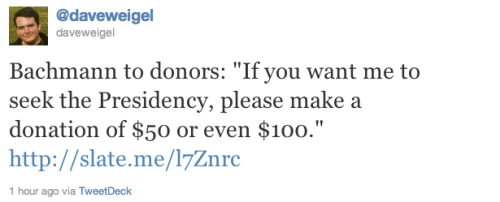
If you want me to seek the Presidency, please send unlimited corporate contributions to Laura Lee, P.O. Box...

Inward Blame has Been a Treasure for the Rich and Powerful

America is the wealthiest nation on Earth, but its people are mainly poor, and poor Americans are urged to hate themselves. To quote the American humorist Kin Hubbard, ‘It ain’t no disgrace to be poor, but it might as well be.’ It is in fact a crime for an American to be poor, even though America is a nation of poor. Every other nation has folk traditions of men who were poor but extremely wise and virtuous, and therefore more estimable than anyone with power and gold. No such tales are told by the American poor. They mock themselves and glorify their betters. The meanest eating or drinking establishment, owned by a man who is himself poor, is very likely to have a sign on its wall asking this cruel question: ‘if you’re so smart, why ain’t you rich?’ There will also be an American flag no larger than a child’s hand – glued to a lollipop stick and flying from the cash register…
Americans, like human beings everywhere, believe many things that are obviously untrue. Their most destructive untruth is that it is very easy for any American to make money. They will not acknowledge how in fact hard money is to come by, and, therefore, those who have no money blame and blame and blame themselves. This inward blame has been a treasure for the rich and powerful, who have had to do less for their poor, publicly and privately, than any other ruling class since, say Napoleonic times. Many novelties have come from America. The most startling of these, a thing without precedent, is a mass of undignified poor. They do not love one another because they do not love themselves.
— Kurt Vonnegut, Slaughter House Five

Thursday, May 12, 2011

Signs of the Times

This is an older article, from last July, but I just discovered it from The Observatory, a design publication.  Michael Zimman writes about how he started buying (for $10 each) and collecting signs on cardboard asking for help.  The article features a slide show of some of the star pieces in his collection.  I was particularly struck by these two and the fact that people without money or homes must make the case that they are still good people.

From the "Being Broke is Not Abnormal" File

Read on Thought Catalog today that 85% of new college graduates are moving back in with their parents after they get their diplomas.

The Moral: If you are stuck with massive college and perhaps credit card debt and unable to find a job, or enough of a job to provide you with your own home, you are not a freak or a pitiful loser.  You are average.  In fact, you are part of the majority.  Relax.

Tuesday, May 10, 2011

Interview with Laura Lee author of Broke is Beautiful

I will be talking about Broke is Beautiful at 5:30 PM EST on May 25, on Scorpion Equinox streaming Internet radio.  You can tune in by following the link above.

Sunday, May 1, 2011

The Truth About American Exceptionalism

"America has been and continues to be exceptional. At first we were exceptional because of circumstances that conferred on us enormous advantages over other nations. Today we are exceptional because of our culture, a culture born of our unusually fortunate history and now perhaps the single biggest handicap to our collective survival and prosperity in the less favorable circumstances of the 21st century."
An excellent article by David Morris in On the Commons takes a look at the culture of American exceptionalism and how it impacts our nation today.  It is worth a read in its entirety, but here are a few highlights:

The central tenet of that culture is a celebration of the “me” and an aversion to the “we”. When Harris pollsters asked US citizens aged 18 and older what it means to be an American the answers surprised no one. Nearly 60 percent used the word freedom. The second most common word was patriotism. Only 4 percent mentioned the word community....

Far more than other peoples, Americans believe that skill and hard work are the keys to success and wealth is a measure of how hard you work or how skilled you are. Which leads us to believe that people should have the right to amass as much wealth as they can and view a graduated income tax as a punitive penalty on success and a sturdy social safety net an invitation to slothfulness, reduced productivity and an overall slowdown in economic growth...

To Republicans, inequality is unimportant because of another aspect of American exceptionalism, the unparalleled opportunity in the United States for those with ambition and grit to move up the economic ladder. They insist, and most of us firmly believe, that America is still the land of opportunity, that the probability of a rags to riches saga is much higher here than abroad.

But recent data contradicts that fundamental tenet of American exceptionalism. A Brookings Institution report comparing economic mobility in the United States and other countries concludes, "…"Starting at the bottom of the earnings ladder is more of a handicap in the United States than it is in other countries." And more broadly notes, "there is growing evidence of less intergenerational economic mobility in the United States than in many other rich industrialized countries.”

...American exceptionalism has bred a culture and value system that have in turn embraced policies that have made the pursuit of happiness exceedingly difficult.