Showing posts with label money. Show all posts

Friday, December 4, 2015

Quote of the Day: I Am Not Ashamed

My net worth is defined by my debt. I have $45,000 in student loan debt, $10,000 in medical debt and $5,000 in back taxes from contracting for nonprofits.  I am not ashamed of a net worth of -$55,000. I am grateful and I am angry.

I am grateful to the people who insisted that I feel no shame by giving me what little they had in the forms of unwavering love and dignity. I am grateful that my communities, family and comrades politicized me to know that my self worth does not directly correlate to my net worth. I am grateful to those who demanded that I know that my debt to these institutions is and should remain only dollars–I do not owe gratitude or obedience to unjust systems.-Kirin Kanakkanatt, Self-Worth > Net Worth

Wednesday, April 17, 2013

Mark Boyle: The Moneyless Man TED Talk

Quote of the Day

"...it's wrong to think of economics as money. The actual word itself actually revolves around meeting one's needs. Money is one way of meeting our needs, but it's only one way."-Mark Boyle, interview Mother Jones

Thursday, March 29, 2012

Quote of the Day: Alan Lightman on the Diminishing Returns of Wealth

“Human beings consider themselves satisfied only compared to some other condition. A man who has owned nothing but a bicycle all of his life feels suddenly wealthy the moment he buys an automobile...But this happy sensation wears off. After a while the car becomes just another thing that he owns. Moreover, when his neighbor next door buys two cars, in an instant our man feels wretchedly poor and deprived.”
― Alan Lightman, Reunion: A Novel

Tuesday, March 20, 2012

Quote of the Day: Working for Belief

If you hire people just because they can do a job, they’ll work for your money. But if you hire people who believe what you believe, they’ll work for you with blood and sweat and tears.— Simon Sinek

Friday, August 26, 2011

Newsflash: The Poor are People

"I’ve learned a lot since I started talking with them. I’m embarrassed now at the assumptions I used to make about them. Without realizing it, I assumed poor people weren’t smart. Or that they weren’t interesting. And that they didn’t know anything about my world. Turns out, it’s not my world. It’s ours. And yes, some of them are obnoxious or weird or mean. But no more so than anyone else. It turns out, poor people are—get this—just people. People who happen to be poor."-Patrick Smith, Losing the Big Coin Toss, The Good Man Project

History of Debt

There is a fascinating interview with David Graeber author of Debt: The First 5,000 Years on the blog Naked Capitalism which turns a lot of our conceptions about the origin of money on its head and which examines the role and consequences of indebtedness on all aspects of society.  I highly recommend the article.  Here are some highlights:

Money evolving out of barter is a myth.  Rather a sense of indebtedness and mutual responsibility came long before an exact accounting of goods for trade.  


Think about what they’re saying here – basically: that a bunch of Neolithic farmers in a village somewhere, or Native Americans or whatever, will be engaging in transactions only through the spot trade. So, if your neighbor doesn’t have what you want right now, no big deal. Obviously what would really happen, and this is what anthropologists observe when neighbors do engage in something like exchange with each other, if you want your neighbor’s cow, you’d say, “wow, nice cow” and he’d say “you like it? Take it!” – and now you owe him one. Quite often people don’t even engage in exchange at all – if they were real Iroquois or other Native Americans, for example, all such things would probably be allocated by women’s councils.
So the real question is not how does barter generate some sort of medium of exchange, that then becomes money, but rather, how does that broad sense of ‘I owe you one’ turn into a precise system of measurement – that is: money as a unit of account?

The first word for "freedom" in any language was related to freedom from debt.

This was the great social evil of antiquity – families would have to start pawning off their flocks, fields and before long, their wives and children would be taken off into debt peonage. Often people would start abandoning the cities entirely, joining semi-nomadic bands, threatening to come back in force and overturn the existing order entirely. Rulers would regularly conclude the only way to prevent complete social breakdown was to declare a clean slate or ‘washing of the tablets,’ they’d cancel all consumer debt and just start over.
 In Sanskrit, Hebrew, Aramaic, ‘debt,’ ‘guilt,’ and ‘sin’ are actually the same word.

Graeber also concludes that our economic system is at tremendous risk because it does not offer enough protection to debtors.

In the past, periods dominated by virtual credit money have also been periods where there have been social protections for debtors. Once you recognize that money is just a social construct, a credit, an IOU, then first of all what is to stop people from generating it endlessly? And how do you prevent the poor from falling into debt traps and becoming effectively enslaved to the rich? That’s why you had Mesopotamian clean slates, Biblical Jubilees, Medieval laws against usury in both Christianity and Islam and so on and so forth.

Since antiquity the worst-case scenario that everyone felt would lead to total social breakdown was a major debt crisis; ordinary people would become so indebted to the top one or two percent of the population that they would start selling family members into slavery, or eventually, even themselves.
Well, what happened this time around? Instead of creating some sort of overarching institution to protect debtors, they create these grandiose, world-scale institutions like the IMF or S&P to protect creditors. They essentially declare (in defiance of all traditional economic logic) that no debtor should ever be allowed to default. Needless to say the result is catastrophic. We are experiencing something that to me, at least, looks exactly like what the ancients were most afraid of: a population of debtors skating at the edge of disaster.
Although governments and banks are behaving differently at the moment, if we recognize debt as a social agreement, we can change and negotiate the terms.

The UK takes the even weirder position that this is true even of debts the government owes to banks that have been nationalized – that is, technically, that they owe to themselves! If that means that disabled pensioners are no longer able to use public transit or youth centers have to be closed down, well that’s simply the ‘reality of the situation,’ as they put it.


These ‘realities’ are being increasingly revealed to simply be ones of power. Clearly any pretence that markets maintain themselves, that debts always have to be honored, went by the boards in 2008...

When thousands of people begin assembling in squares in Greece and Spain calling for real democracy what they are effectively saying is: “Look, in 2008 you let the cat out of the bag. If money really is just a social construct now, a promise, a set of IOUs and even trillions of debts can be made to vanish if sufficiently powerful players demand it then, if democracy is to mean anything, it means that everyone gets to weigh in on the process of how these promises are made and renegotiated.” I find this extraordinarily hopeful.


A truly interesting read worth checking out in full via the link above. I've also added Debt: The First 5,000 Years to my (overly long) to read list.

Sunday, May 29, 2011

Starving Artist Quote of the Day: The Grumpy Version

I could see the road ahead of me. I was poor and I was going to stay poor. But I didn’t particularly want money. I didn’t know what I wanted. Yes, I did. I wanted someplace to hide out, someplace where one didn’t have to do anything. The thought of being something didn’t only appall me, it sickened me…To do things, to be part of family picnics, Christmas, the 4th of July, Labor Day, Mother’s Day…was a man born just to endure those things and then die? I would rather be a dishwasher, return alone to a tiny room and drink myself to sleep.
Charles Bukowski

Monday, May 23, 2011

Nothing but a Number

“Money is a human creation. It is nothing but a number. Most of it is simply accounting entries in computer files. It has no existence, reality, or value outside the human mind. It is extraordinary that we, a supposedly intelligent species that prides itself on creating a great civilization based on popular democratic self-rule, allow money, a system of accounting entries, to rule our lives. Has it ever struck you how absurd it is that as a society we have so much work that needs doing and at the same time, so many unemployed people who would love to be doing productive work? How absurd, that two of our defining problems are homeless people and vacant houses? We are told there is no money to put the unemployed people to work meeting unmet needs and to put the homeless into the empty houses. What a powerful demonstration of system failure.”-David Korten

Thursday, May 19, 2011

God and Money: Is Your Religion Your Financial Destiny?

The New York Times has an interesting article on the correlation between religions affiliation and income which, it reports, is much larger than the differences among states and even larger than those among racial groups.

The most affluent of the major religions — including secularism — is Reform Judaism. Sixty-seven percent of Reform Jewish households made more than $75,000 a year at the time the Pew Forum on Religion and Public Life collected the data... On the other end are Pentecostals, Jehovah’s Witnesses and Baptists. In each case, 20 percent or fewer of followers made at least $75,000.
The main driver of the religion/wealth divide is education, according to the study's authors.  The religious groups that had the most educated members, on average, also had the greatest wealth. 

The relationship between education and income is so strong that you can almost draw a line through the points on this graph. Social science rarely produces results this clean.  What about the modest outliers — like Unitarians, Buddhists and Orthodox Christians, all of whom are less affluent than they are educated (and are below the imaginary line)? One possible explanation is that some religions are more likely to produce, or to attract, people who voluntarily choose lower-paying jobs, like teaching.
You can see the graph yourself and read the full analysis by following the link above.

Wednesday, May 18, 2011

Maybe I Should Try That


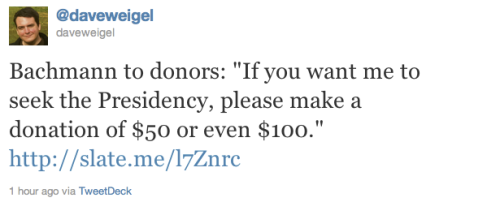
If you want me to seek the Presidency, please send unlimited corporate contributions to Laura Lee, P.O. Box...

Inward Blame has Been a Treasure for the Rich and Powerful

America is the wealthiest nation on Earth, but its people are mainly poor, and poor Americans are urged to hate themselves. To quote the American humorist Kin Hubbard, ‘It ain’t no disgrace to be poor, but it might as well be.’ It is in fact a crime for an American to be poor, even though America is a nation of poor. Every other nation has folk traditions of men who were poor but extremely wise and virtuous, and therefore more estimable than anyone with power and gold. No such tales are told by the American poor. They mock themselves and glorify their betters. The meanest eating or drinking establishment, owned by a man who is himself poor, is very likely to have a sign on its wall asking this cruel question: ‘if you’re so smart, why ain’t you rich?’ There will also be an American flag no larger than a child’s hand – glued to a lollipop stick and flying from the cash register…
Americans, like human beings everywhere, believe many things that are obviously untrue. Their most destructive untruth is that it is very easy for any American to make money. They will not acknowledge how in fact hard money is to come by, and, therefore, those who have no money blame and blame and blame themselves. This inward blame has been a treasure for the rich and powerful, who have had to do less for their poor, publicly and privately, than any other ruling class since, say Napoleonic times. Many novelties have come from America. The most startling of these, a thing without precedent, is a mass of undignified poor. They do not love one another because they do not love themselves.
Kurt Vonnegut, Slaughter House Five

Saturday, April 23, 2011

I Am Quite Indifferent To It

"...I have never had money, and because I am not used to having any, I am quite indifferent to it.  I simply cannot make myself work for money."-Anton Chekhov

Tuesday, April 19, 2011

The Illusion of Money: Yet Another Thing That Makes You Spend Too Much

Dan Ariely, a Duke University behavioral economist, and author of the book Predictably Irrational, suggests that the complexity of the U.S. tax code is yet another force that leads Americans to spend more than we can afford:

In the US, we all know the gross amount that we make a year, but it’s not as clear what our net income is. It’s actually very complex because we get our salary, some of which the employer withholds, and we have no idea what we’ll get back when tax day comes around. We can get back some money (depending on our expenses/deductibles), trends in our stock market portfolio, health care, etc. And we don’t figure this out until April 15th (if not later) of the following year!

And what are the consequences of knowing our gross yearly income and not much else? I think it causes us to feel richer than we really are and spend accordingly. Why would this be the case? There’s a phenomenon we call the “illusion of money,” which is the idea that we typically pay attention to nominal amounts of money rather than real amounts. For example, the illusion of money means that if inflation is 8%, and you get a 10% raise, you would feel better than if there was no inflation and you got a 3-4% raise. The basic idea is that we pay attention to the nominal amount rather than the purchasing power, and don’t realize what our money is really worth.

In terms of our tax code, this suggests that in the US we focus on our gross yearly income, feel richer than we really are, and consequently end up spending more money.

Monday, April 11, 2011

Wow, You Have Two Million

“When their (British) Who Wants to Be a Millionaire? finally had a million-pound winner, newspapers looked through the society registers and then pounced: the winner was already wealthy, they announced. How dare she win another million pounds? And here is their difference from us. First, no American would bother to find out the assets of a quiz show or lottery winner. And while there is class resentment in America, the poor do not take it to a personal level: they vent at the mayor, at the police, at local businesses, at other poor people, at everyone but the rich themselves - because they want to be rich too, and would do the same. If you have a million and win another million, Americans will not spit at you. They will say, 'Wow. Now you have two million.'"-Paul Collins, Sixpence House

Friday, April 8, 2011

Quote of the Day: Money is Like Fire


"Money is like fire, an element as little troubled by moralizing as earth, air and water. Men can employ it as a tool or they can dance around it as if it were the incarnation of a god. Money votes socialist or monarchist, finds a profit in pornography or translations from the Bible, commissions Rembrandt and underwrites the technology of Auschwitz. It acquires its meaning from the uses to which it is put."- Lewis H. Lapham,  Money and Class in America

Thursday, April 7, 2011

How Should We Spend Ourselves?

Every once in a while I find myself in need of a Quaker perspective on maps and I turn to mapHead the blog of Nat Case.  (He's a Quaker and head of production for Hedberg Maps and writes about both mapping and his faith.) One of the fundamental tenants of Quakerism is the importance of simple living.  On March 7, Nat posted a thoughtful article questioning our assumptions about the economy and what we value:

...something that's been bugging me for a while now, a sense that our fundamental terms of discussion on economic issues are missing the point, over and over.

First, the use of "jobs" to mean "earned income." We're used to wage employment being the primary source of sustenance for most American families, but this is pretty new, globally speaking. The move by more and more friends and acquaintances to grow at least some of their own food is striking, and I think points to a broadening sense that wage labor is not the only way to go in terms of providing for oneself. When we say "we want everyone to have a job" what we ought to be saying is "we want everyone to work such that they can sustain themselves and have time and energy for the pleasures and joy of life"

Second, the sense that money is the fundamental unit of economic measure. It is certainly the most easily quantifiable measure—maybe the only easily quantifiable measure. But in the end, it is a measure, not the thing itself. A dollar is a unit of exchange. As has been pointed out countless times, you can't eat gold. The focus on money also means we ignore non-monetized parts of the economy...
 The core economic question is not "how much money do we get for our work?" but "how should we spend ourselves?" because whatever we earn in cash, when we work we are spending time out of our lives. The product, whether it is fungible or not, is what we should pay attention to. Not everything needs to be exchangeable on the open market.

You can read the full article here.

Thursday, March 24, 2011

Quote of the Day

"I really am in this game seriously for something besides money and... I'd rather live on less and preserve the one duty of a sincere writer-- to set down life as he sees it as gracefully as he knows how."-F. Scott Fitzgerald

Monday, December 20, 2010

Surplus Wealth May Rob You of Your Ability to Savor Small Pleasures

New research by Jordi Quoidbach and colleagues in the journal Psychological Science add to the growing body of literature on money and subjective well being, which indicate that money cannot buy happiness.

The authors of this study conclude that having access to the best things money can buy actually reduces a person's ability to savor small pleasures.  Savoring an experience gives you double the pleasure.  There is the pleasure of the experience itself, and the experience of remembering it, recounting it, reliving it.

This study provides the first evidence that money impairs people’s ability to savor everyday positive emotions and experiences. In a sample of working adults, wealthier individuals reported lower savoring ability (the ability to enhance and prolong positive emotional experience). Moreover, the negative impact of wealth on individuals’ ability to savor undermined the positive effects of money on their happiness. We experimentally exposed participants to a reminder of wealth and produced the same deleterious effect on their ability to savor as that produced by actual individual differences in wealth, a result supporting the theory that money has a causal effect on savoring. Moving beyond self-reports, we found that participants exposed to a reminder of wealth spent less time savoring a piece of chocolate and exhibited reduced enjoyment of it compared with participants not exposed to wealth. This article presents evidence supporting the widely held but previously untested belief that having access to the best things in life may actually undercut people’s ability to reap enjoyment from life’s small pleasures. 

Tuesday, November 2, 2010

Vow of Poverty

The Daily Episcopalian printed a thoughtful sermon by Richard E. Helmer on the spiritual vow of poverty and its meaning. Here is an excerpt:
When I recently attended the life profession of a Franciscan brother in San Francisco, the preacher at the service made note of a critical aspect of Franciscan spirituality, rooted as it is so deeply in the heart of the Gospel of Jesus Christ. “Poverty,” he said, “is not the absence of riches.” For Francis discovered a different kind of riches when he set aside the affluent lifestyle of his family and renounced his material inheritance. He discovered a charisma that built a movement capturing the attention of popes and prelates, politicians and peoples, and the imagination of a Christianity yearning to free itself of corruption. He discovered a wealth of inspiration that brought about the rebuilding of churches throughout Assisi and beyond, and radically challenged the indolence of overly wealthy monastic communities and the machinations of ecclesiastical officials.

“Poverty is not the absence of riches, but the absence of power.”

Francis gave up control over his own destiny, and made no pretense to take the helm of the movement his witness unleashed. While he was called upon to engage in high-level conversations with the rich and the powerful, he eschewed authority for simplicity and lived quietly and generously in a society of friars and sisters for many years. It was entirely the work of the Spirit moving among the people that re-formed Western Christianity subversively and from within at the height of the Middle Ages. When Francis embraced poverty, he gave up his personal power to control what God was doing in his midst and through him. And in an irony worthy of the Gospel of Jesus Christ, Francis became more powerful than he could have imagined, perhaps in the way our prayers in the Daily Office offer as a closing benediction: “Glory to God whose power working in us can do infinitely more than we can ask or imagine.”