Friday, October 9, 2009

Creativity and Constraints

Much of the time when we use the word "creativity" we're actually talking about "imagination" or "originality." The difference between these terms can be found right in the word. To be "creative" you have to create. Imagination is only a first step.

To let your imagination roam free, you need to let go of your pre-conceptions, limiting beliefs and constraints. But for creativity you need to welcome useful constraints back in. The right kind of constraint can provide the framework for innovative creation. This is good news for the broke among us. Limited resources are a great constraint that can force you to be more innovative with what you've got.

Today, over at Boing Boing, is a review of the book Junky Styling: A manual for thrift-shop clothes remixers. It is written by the proprietors of London's Junky Styling, a clothing boutique that takes thrift-store finds and re-imagines and re-constructs them into one-of-a-kind fashion statements. It just goes to show that buying second hand doesn't mean you have to abandon fashion or resign yourself to being out of date. With a little creativity-- and a sewing machine-- your budgetary constraint can be the springboard to an entirely original you.

Follow the link above to read more about the store's proprietors on Boing Boing or visit the Junky Styling web page.

Thursday, October 8, 2009

Worst Case Scenario?

Mother Jones published feature by David Corn on Harvard Professor Elizabeth Warren. The article dubs her the "bank buster."

Warren is pushing a proposal to create a Financial Product Safety Commission to protect consumers from abusive lenders. Mortgages and credit cards, she wrote in a 2007 journal article about the proposal, "should be subject to the same routine safety screening that now governs the sale of every toaster, washing machine, and child's car seat."

The response from the banking industry has been predictable. They don't like the idea. An industry lobbyist, Bill Himpler, says Warren's commission would "take us essentially back to the 1970s, where we had... one-third the consumer credit available that we have now."

Would having less consumer credit be a terrible thing? If I understand this treat correctly, Himpler is saying, "if you don't allow us to take advantage of a few customers now, you'll hinder our ability to allow people to get in over their heads with debt, and no one wants that."

Man Goes 9 Years without Using Money

Courtesy of Alternet:

Daniel Suelo wasn't poor, a victim of bad luck, mentally ill, or even uneducated. He just decided that he wanted to have nothing to do with money. So he gave up consumer culture altogether, and for the last 9 years, he's survived by living in a cave in Utah, and dumpster diving, foraging, fishing, and occasionally hunting for food. He spends his time in the great outdoors--and in the public library, where he blogs about it all.


Want to read it? I Know It Is Possible to Live with Zero Money

Resourcefulness Celebrated

From last night's Daily Show, an interview with a person who truly embodies the Broke is Beautiful spirit. William Kamkwamba of Malawi was inspired by a diagram in a library book to use salvaged materials to build an electricity generating windmill for his village. (It's a good thing Constantine Xios didn't live in his village.)


The Daily Show With Jon StewartMon - Thurs 11p / 10c
William Kamkwamba
www.thedailyshow.com
Daily Show
Full Episodes
Political HumorRon Paul Interview

Mommy, Why is that Mean Man Shouting at Me?

Ebenezer Scrooge is alive and well and living in the Chicago Suburb of Oak Brook.

Broke is Beautiful, which could not conceivably been written without the help of librarians, includes a chapter I titled Librarians: A Love Story. (In my book, it's a real love story, not like Michael Moore's love story about capitalism.)

It was the radical Benjamin Franklin who came up with the notion of the lending library. Franklin’s Library Company, which he referred to as the “public library of Philadelphia,” was formed with an idealistic view to break down class distinctions and allow artisans to become as well-read as the well-born. It was an early manifestation of The American Dream and its ideal of a true meritocracy and social mobility.

"These libraries have improved the general conversation of the Americans, made the common tradesmen and farmers as intelligent as most gentlemen from other countries, and perhaps has contributed in some degree to the stand so generally made throughout the colonies in defense of their privilege,” Franklin wrote in his autobiography.

Constantine "Connie" Xinos is perfectly fine with class distinctions. He once successfully blocked a permit for a senior's home, stating, "I don't want to live next to poor people. I don't want poor people in my town."

As reported in The Daily Herald, Xinos, the president of the home-owners' association in a gated community, hates such socialist instutitions as libraries--He reportedly worked to elect an Oak Brook village council who would shut down the town library, which he also campaigned against-- and thinks little children should be taught a lesson in personal responsibility.

When local kids showed up at town meetings to ask that their library be left open, he is quoted as saying, "I don't care that you guys miss the librarian, and she was nice, and she helped you find books."

When he brought a little girl to tears, he was not fazed. From the comfort of his Mercedes-Benz, he later told Daily Herald reporter Burt Constable: "I wanted that kid to lose sleep that night... This is the real world and the lesson, you folks who brought your kids here, is if you want something, pay for it."

Wednesday, October 7, 2009

Newsflash: Consumers Angry at Credit Card Companies!

Shocking!

Consumer Reports says:

More than a one-third (32%) have paid off and closed a card since January 2008, and half of those that canceled did so in direct response to the actions of credit-card issuers, such as cutting limits, hiking rates, or imposing fees, according to a national poll by Consumer Reports.

Twenty-one percent of respondents said they were treated unfairly by card companies, and only 41 percent said they were highly satisfied with their card issuer, making credit cards one of the lowest rated services that Consumer Reports covers.

Schadenfreude Headline of the Day


Hummer drivers get five times as many speeding tickets as the average driver. Courtesy: Consumer Reports.

Tuesday, October 6, 2009

Word of the Day: Plutolatry- The Worship of Wealth

Did you know that there is a movement among some right-wing conservative Christians to re-translate the Bible to make its language more in line with their ideology? I learned this today via the blog Below the Beltway.

Some of the suggestions seem like fairly reasonable updates to make the text more easily understood by a modern reader such as using "register" rather than "enroll" in the census or "gamble" instead of "cast lots."

(I, personally prefer the poetry and the cultural tradition of the King James version, even if scholars are in agreement that it is probably one of the worst translations out there.)

Other changes are more contentious such as eliminating gender neutral language, getting rid of "liberal" words like "comrade" and replacing them with words like "volunteer" and pumping up references to the devil and Hell.

For our
Broke is Beautiful purposes, the most interesting suggestion is number 7: "Express Free Market Parables; explaining the numerous economic parables with their full free-market meaning."

The political right has for some time mixed conservative Christian faith with an almost equal religious faith in free markets. The concept of Free Market Fundamentalism as a religion has been recognized by economists and theologians alike.

Economics professor Richard Wolf put it this way: "an unregulated economy, with free markets and private enterprise is a magic road to prosperity and growth. Particularly in the last 30 years, that has become a mantra. It’s the Morning Prayer with which every economics department begins."

Harvey Cox, professor of divinity at Harvard University penned an article for the Atlantic Monthly in 1999 titled The Market as God. Cox argued that “there lies embedded in the business pages and entire theology, which is comparable in scope if not in profundity to that of Thomas Aquinas or Karl Barth.”

He came to this belief after observing the reverence that The Market inspired in business people. “Such is the grip of the current orthodoxy that to question the omniscience of The Market is to question the inscrutable wisdom of Providence,” he wrote. “I am beginning to think that for all the religions of the world, however they may differ from one another, the religion of The Market has become the most formidable rival, the more so because it is rarely recognized as a religion.”

Faith in Free Markets as a God is one thing, but using Christianity to support it always seemed contradictory given what I read in The Bible. Now I see my confusion may just have been the result of a faulty translation.

For example 2 Corinthians 8:9:
"For you know the grace of our Lord Jesus Christ, that though He was rich, yet for your sakes He became poor" is really just a celebration of Free Markets when you read it right.

(For more see the Top Verses That Televangelists Won't Preach on the blog Tithe Stewardship and Church Tithing and my own entry on the irony of the prosperity gospel church selling its private jet.)


*Please excuse my font issues. I can't figure out how to make the text consistent.


Save the Environment by Wasting!

During World War II, our government distributed posters like this one to let the American public know that thrift was patriotic. (If you'd like to see more, visit Northwestern Unversity's World War II Poster Collection.)

For the past few decades thrift has taken a back seat to consuming as a show of patriotism. Remember when George W. Bush encouraged us all to go shopping after September 11?

A great illustration of this "save the nation through waste" philosophy in action was the Cash for Clunkers program. I liked the idea of a program that gave Americans both an incentive to support the auto industry-- I am from Detroit after all-- and to do so by buying more fuel efficient vehicles. On its face it sounded green and ingenious. The public loved it too. What's not to love about a great big discount on a major purchase?

I immediately changed my mind when I learned that the old, perfectly working "clunkers" had to be destroyed and crushed. With the exception of only a few components, they couldn't even be used for parts to maintain current vehicles. I could not figure out how this massive waste could really save the environment. (This is not even addressing the issue of the disposal of mercury switches in older vehicles that the pre-bankrupcy GM would have been responsible to clean up but the "New GM" insists it is not.) Surely the energy saved by the more fuel efficient cars would be offset by the energy it would take to make entirely new vehicles, and new parts for other older vehicles, rather than using existing working cars and salvage parts.

The Wall Street Journal just published an analysis of the Cash for Clunkers program and it concluded exactly that.

According to Hudson Institute economist Irwin Stelzer, at best “the reduction in gasoline consumption will cut our oil consumption by 0.2 percent per year, or less than a single day’s gasoline use.” Burton Abrams and George Parsons of the University of Delaware added up the total benefits from reduced gas consumption, environmental improvements and the benefit to car buyers and companies, minus the overall cost of cash for clunkers, and found a net cost of roughly $2,000 per vehicle. Rather than stimulating the economy, the program made the nation as a whole $1.4 billion poorer.

The basic fallacy of cash for clunkers is that you can somehow create wealth by destroying existing assets that are still productive, in this case cars that still work. Under the program, auto dealers were required to destroy the car engines of trade-ins with a sodium silicate solution, then smash them and send them to the junk yard. As the journalist Henry Hazlitt wrote in his classic, “Economics in One Lesson,” you can’t raise living standards by breaking windows so some people can get jobs repairing them.

Monday, October 5, 2009

No Such Thing as a Free Lunch

Have you ever gotten into a debate about whether it is actually cheaper to pack a lunch or to just buy something from the fast food stand in the lobby? (Incidentally, did you know that the Louvre in Paris is about to get its very own McDonald's?)

Cockeyed.com, which has also made it a mission to quantify how much is actually inside product boxes, has a handy sandwich calculator. Choose your style of bread and toppings and voila! You can see just how much that sandwich will cost you. My avacado and swiss on rye came to $1.79.

Sunday, October 4, 2009

Urban Foraging in the News


Urban foraging is what you call garbage picking if you're of a high enough social class to have a choice in the matter. Liberating waste, which is one of the topics covered in the forthcoming Broke is Beautiful, is featured in an article in The Guardian with the attention getting title America is a Toxic Dump.

Sadhbh Walshe begins her article by saying some languages have no word for garbage. If you actually follow the link that supports this claim though, it takes you to a blog which features the sentence "it is said that the Tagalog language had no word for garbage." A writer rarely writes "it is said" unless they have no proof to back something up. So it's a fact that ought to be true, even if it is probably not.

Freeganism, another new-fangled term for the age old practice of liberating perfectly usable stuff from dumpsters, is big these days. You know it is mainstream when Oprah does a feature. Walshe briefly discusses her adventures on an organized foraging tour in New York.

I had intended only to be a casual observer, but when I saw the range of goodies on offer – organic still fresh fruits and vegetables, fancy olive breads, cured meats, bagels, donuts and other delectables, still sealed in non-biodegradable packaging, it seemed an awful shame to let it go to waste. Another dumpster dive led me to more durable goods like books, clothes, toys, furniture and electronic items in near perfect condition. Nothing, it appears, is too good to be discarded here.Unfortunately only a tiny percentage of the city's refuse is reclaimed by foragers. The rest (which amounts to about 4,385,000 tons a year) is gathered by collection trucks which instantly crush it into compact piles, eliminating the possibility of further salvaging.


Saturday, September 26, 2009

Things You Can Do with Duct Tape


Thank you to Jen Lee for making me aware of the "There, I Fixed It" page. A collection of images of unglamorous fixes. It is a celebration of making do that is completely in the "Broke is Beautiful" spirit.

Think You're the Only Poor Slob in the "Richest Nation on Earth?"

Broke is Beautiful: Living and Loving the Cash Strapped Life, due out in Spring, is now listed on Amazon.com for pre-order. It has no cover yet, but you can put in your order anyway!

As we get closer to its release date I will start posting stories related to its theme: Enjoying your life as a broke person and being the best darned broke person you can be.

The Huffington Post put up a clip today from Bill Maher's show on HBO. (Who can afford premium channels?) I am passing it along because the panelists discuss one of the themes in the book. You're not worse off than everyone around you! Studies have shown that television viewers tend to mistake the characters they see on the box for their actual peers on some level, yet the folks on TV live lives of material abundance well beyond what you can get with your meager salary. How? The magic of fiction. Unfortunately those of us in the reality-based economy find it a bit hard to keep up, which gives us the impression that we're the only ones treading water. Relax. There's a lot of company in your pool.

Thursday, September 17, 2009

Broke is Beautiful

Coming in Spring 2010 is my new book Broke is Beautiful. As the release approaches I will be using this space to talk about the upsides of the down economy. In the meantime, here is a film from The Onion on culture clashes between the old poor and the nouveau poor.


Report: Growing Ranks Of Nouveau Poor Facing Discrimination From Old Poor

Tuesday, September 15, 2009

Do Not Tire of Doing Good

In an article published last September. MSNBC reported that Pope Benedict continued with a campaign started by his predecessor, John Paul II, who worried that the affluent West was turning consumerism into a kind of religion and ignoring its Christian roots of spiritual values.

Paraphrasing from the New Testament, Benedict decried “insatiable greed” and said “the love of money is the root of all evil.”

“Have not money, the thirst for possessions, for power and even knowledge, diverted man from his true destiny?” the pope asked.

Benedict blasted modern society’s thirst for these new “pagan” idols as a “scandal, a real plague.”

The pope urged the faithful to “shun the worship of idols. Do not tire of doing good!”’


Read more: Pope condemns love of money, power - The Vatican- msnbc.com

Wednesday, June 10, 2009

Schadenfreude 19th Century Style

Stay tuned for updates on my new book Broke is Beautiful due out in spring 2010. In the meantime, I came across a site courtesy of Boing Boing that is directly relevant to my last book Schadenfreude, Baby and felt compelled to pass it along.

The Hope Chest: Bad news from the past is a blog that reproduces late 19th/early 20th century bad news reports from various American newspapers, with a little snappy commentary at the end.

Saturday, April 18, 2009

Political Irony of the Day

Courtesy Randy Cassingham's "This is True":

Thursday, January 8, 2009

Monday, November 17, 2008

100 Most Dangerous Things


I am in the process of envisioning a slightly different focus for this blog to continue talking about the subjects of all- not just one-- of my books. This will be a challenge with books ranging in topic from Elvis Impersonation to the weather and ballet. Still it is worth a shot.

I came across an article today that could have formed a chapter in The 100 Most Dangerous Things in Every Day Life and What You Can Do About Them, had it not, you know, come out four years after the book did.

The New York Times is reporting on the bane of shoppers existence-- clamshell packaging. You know, the kind of inpenetrable plastic theft prevention prophylactic that you need a pocket knife to open and which occasionally results in the accidental slashing of your fingers.

It has sent about 6,000 Americans each year to emergency rooms with injuries caused by trying to pry, stab and cut open their purchases, according to the Consumer Product Safety Commission.

Companies like Amazon and Sony are working on alternatives which may make your holidays brighter this year.

In case you are confronted with a clamshell anyway, WikiHow suggests using a can opener to get inside.

Friday, November 7, 2008

Schadenfreude Headline of the Day

From the Huffington Post:

Right-Wing Attack Group Funder Goes Bankrupt

I Am Out of the Office Right Now. Please Print this on a Sign.


Aren't translation gaffes fun?

Here is a sign in Wales where law requires everything be posted in both English and Welsh.

The Swansea council was ready to put up a sign reading "No entry for heavy goods vehicles. Residential site only." So they fired off an e-mail to their regular translator and received a reply, which was duly printed on the sign.

There was only one problem, the e-mail was an autoresponder. The sign to the left tells Welsh truckers: "I am not in the office at the moment. Send any work to be translated."

If you like to read about fun with electronic translation and other translation gaffes, the BBC story on this sign features some links to similar escapades.

Monday, October 27, 2008

Want to Feel Rich? Ok, You’re One of the Richest People in the World

Seriously, if you have a toilet to flush you’re doing better than one billion people on earth. That is the number of people who do not have a sanitary system of any kind where they live. One third of the planet is that poor. Having to cancel your Netflix subscription doesn’t seem like such a hardship now does it?

If you make $10,787 a year, the U.S. poverty line for an individual, you are in the top 13% of wealth in the world. If you make the median salary of a U.S. man, $43,460, you are in the top 2.17% richest people on the earth. Source: Globalrichlist.com, which has a cool calculator that allows you to put your wealth in international perspective. Type in your income and see how rich you are.


If I Were A Rich Man - Topol

Wednesday, October 22, 2008

Her Name is Rio-- No, Really, her name IS Rio

Jim Geraghty over at the National Review engaged in a little smirky sacrasm defending the GOPs challenges of registered voters in New Mexico. He noted that there were a number of problems with newly registered voters in that state that indicate widespread fraud. His piece de resistance? A registration for someone claiming to be "Duran Duran.":

Now, unless A. Serwer thinks that there is actually a registered voter named "Duran Duran" in New Mexico, he ought to refrain from sputtering that those who disagree with him are 'racist' and 'paranoid.'

The person who is "Duran Duran" almost certainly voted under their real name, and thus got two votes in the primary. God knows how many of those 27 others exist; for all we know, one person might have cast all of them. Anybody who voted once had their vote diluted by the guy who cheated to vote two to twenty-seven times.


Check and mate A. Serwer! Oh, but hold on a minute. There's one little detail I should mention. Duran Duran is actually a voter. Geraghty was forced to tag this amendment to the end of the story:

UPDATE: I am floored by the fact that the white pages for Albuquereque, New Mexico has a listing for "Duran Duran." Mea culpa.


Doh!


Come Undone - Duran Duran

Sunday, October 19, 2008

Fail

Slate magazine is writing an obituary of the term "schadenfreude." The new fun failure expression is "fail."

In an article entitled "Epic win: Goodbye schadenfreude, hello fail." Christopher Beam traces the origin of the expression to a 1998 Neo Geo arcade game called Blazing Star. If you beat a level, the screen flashes with the words: "You beat it! Your skill is great!" If you lose you're chided with this poor Japanese to English translation: "You fail it! Your skill is not enough! See you next time! Bye bye!"

It also introduces the current word for a form of schadenfreude, lulz, the questionable pleasure of hurting someone's feelings on the Web.

Schadenfreude is so 2007. I fail it. Bye Bye.

Saturday, October 18, 2008

Hard time for Mimes


The Gawker is reporting that economic hard times are having a devestating effect on mimes, although they haven't been talking much about it.

Silence is golden - Tremeloes

Weather Control by 2000?

In honor of the news that my book Blame it on the Rain, which discusses how weather changed history, is soon to be published in Polish…

Paleo-Future, a Web site devoted to past futurism, recently posted a clip from a 1966 program 2000 A.D. The clip predicts a 3 day work week by 2000.

From there it goes on to predict weather control: "My estimate is that we will start to work seriously to modify thunderclouds to reduce lightning. I think that we'll be able to have some sort of estimate of whether we can control tornadoes and such local severe storms."

Weather control is no mere whimsy. As I noted in Blame it on the Rain, scientists (and quite a few quacks) have been working on it for years. They're just not very good at it.

In the late 19th century the Weather Bureau and the Department of Agriculture funded various tests in which explosives were unleashed in the clouds to release their rain. Money that The Chicago Times believed would have been “less ridiculously employed if it were devoted to the attempted manufacture of whistles out of pig’s tails.”

One of the first successful attempts was in 1946 when a high school dropout named Vincent Schaefer, who was employed by General Electric, flew above the Schenectady, New York clouds and dropped six pounds of dry ice into them. The result was snow.

A year later, Schaefer and Irving Langmuir, a Nobel laureate in chemistry, tried to change the course of a hurricane threatening the Florida coast. They dumped almost 200 pounds of dry ice into its eye. As they predicted, the storm changed direction. The experiment would have been a complete success were it not for the fact that the new path put the storm on a collision course with Savannah, Georgia, where it did about $5 million in damage.

As early as 1957, a report of Eisenhower’s advisory committee noted that weather control could become a “more important weapon than the atom bomb.” In 1966, the U.S. got a chance to try it out. “Project Popeye” dispensed a rain-making agent into the clouds of Vietnam and extended the monsoon season in order to increase the mud on the Ho Chi Minh trail—the main enemy supply route to South Vietnam. Whether or not these attempts were successful depends on whose report you read.

Of course, American generals were not the only ones to think of this. In Soviet Russia scientists were looking for ways to modify weather using laser technology. Recently declassified documents in England reveal that a storm that dropped 9 inches of rain in only 21 hours in August of 1952 came after a secret rainmaking experiment in which the military seeded clouds with silver iodine powder. The storm created a flood that swept through the costal town of Lynmouth destroying bridges, buildings and roads. The flood killed 34 people.

Weather control seems, for the foreseeable future, to remain the stuff of science fiction.

I Cant Stand The Rain - Tina Turner

Friday, October 17, 2008

Lazy Post of the Day

Earlier on this blog, in an entry titled "Changing My Name to AIG," I featured Arlo Guthrie's performance of Tom Paxton's Changing My Name to Chrysler. Well, looks like Arlo's changed his name again. Enjoy.

Wednesday, October 15, 2008

More Fun with Family Values

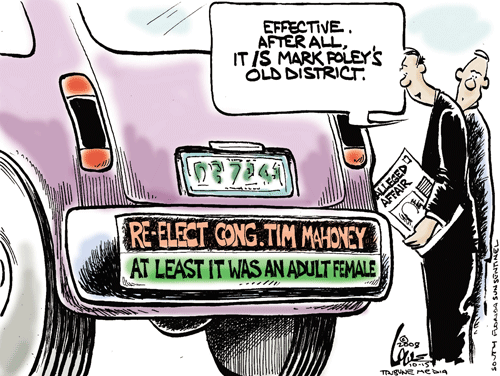
There are so many lovely ironic tales of "family values" politicians falling from grace that Schadenfreude, Baby! did not even need to include Mark Foley. Remember Mark Foley? Two years ago CNN viewers were invited to obsess over his sexual e-mails to male congressional pages.

"After being caught sending explicit emails to underage boys, Florida congressman Mark Foley has resigned," Jay Leno quipped. "So his seat is up for grabs, which is what got him in trouble in the first place."

Foley slunk off in humiliation and in rode a Democrat, Tim Mahoney, on a white steed promising to restore integrity to the office. A socially conservative married father, Mahoney ran on a “Faith and Families” platform.

If you've followed politics at all, you've probably already guessed the punch line. Mahoney has bonked himself into a scandal of his own. He had an affair with one of his staffers and just for good measure, fired her in a mean and nasty recorded telephone call and then agreed to pay her $121,000 in hush money.

This story just goes to show that family values hypocricy is not the sole property of the Rebpublican party. But wait, our friends at Political Irony have pointed out yet one more twist in the story.

"...it will be difficult for Republicans to wave this an example of how Democrats are just as corrupt as Republicans, because Mahoney was actually a Republican who was recruited to run as a Democrat against Foley in the first place. Since being elected, Mahoney has voted with the Republicans almost as much as he has voted with the Democrats."

Oh dear.


Cartoon © Chan Lowe

Sunday, October 5, 2008

Political Parties

The legal blog Infamy or Praise has a regular feature it calls Thank God its Schadenfreude. On September 12, it refrenced a story in The Register about an Australian government minister, Matt Brown, who was forced to resign after an embarassing boogie woogie in his tiny whiteys during a drunken party at his Parliament House office.

The greatest part of the story was the quote by the minister's boss state premier Nathan Rees, who told Fairfax Radio Network: "I subsequently put it to former minister Brown late last night that there are too many reports of you in your underwear for me to ignore."

Thursday, October 2, 2008

Broke Brokers Nothing New

According to Sereno Pratt’s book The Work of Wall Street: “The word broker is old. The early English form was broceur. By some it is believed to be derived from the Saxon word broc, which meant, misfortune and the first brokers indeed appear to have been men who had failed in business as principals and been compelled to pick up a precarious living as agents.” Too much greed, too many gambles, bad luck and out and out stupidity have all been known to lead to financial ruin.

The Internet and the news media continue to buzz with people describing their sense of pleasure at seeing the rich fare poorly. The number of "schadenfreudes" in recent news stories are too numerous to recount. The Boston Phoenix added a little color today by coining "schadenfreude-riffic."

"Turns out, Wall Street’s just as fallible as me," wrote Kara Baskin. "I know it’s kind of unpatriotic and cruel, but there’s something schadenfreude-riffic about watching arrogant and formerly rich assholes scurry for help, tails between their legs. The New York Times said it best: 'Wall Street traders began to believe that the values they had assigned to all sorts of assets were rational because, well, they had assigned them.'”

Wednesday, October 1, 2008

Our Winning Word: SADENFREUDE

Sadenfreude n. An emotion that combines joy in another's misfortune tempered only by the overriding sense that the misfortune is going to have some serious and sad consequences.

Seeing fat cats laid low has always produced an emotion the Germans call Schadenfreude, defined in English as "joy in another's misfortune." I should know, I wrote a book on the subject, Schadenfreude, Baby! published by Lyons Press.

The past few weeks have been a good time for Schadenfreude watchers. If you have a Google alert set to "Schadenfreude" you have seen it go crazy recently with observers of all stripes expressing something other than empathy for failed investment bankers. But it's hard to feel too gleeful. The emotion we're experiencing is different than our old school Schadenfreude over Brittney Spears and Paris Hilton.

“There would be something comical, even pleasurable, in watching the frenetic agitation of the banking world”, wrote Laurent Joffrin, editor of Libération newspaper, “if millions of jobs were not at stake, not to mention the economic balance of the planet.”

We need a new word to describe the mix of emotions we're feeling which is why I called for submissions from the general public on my blog www.schadenfreude-baby.blogspot.com.

The winning word was submitted by Tom Lennon of England who coined "Sadenfreude: Taking pleasure from others misfortune while feeling rather sad about it."

Other entries included karmaglee; desletsenium, a mix of three different latin terms for a regretful feeling of Schadenfreude; Eupheria or Schadenfreude tinged with fear of impending financial doom; trickledownpathoshumorism, and Himmeldonnerwetter, "brought to you by the same folks that gave you schadenfreude!"

Related neologisms submitted included "neoconomitus -- the shared malaise that comes from failed neoconservative economic policies and practices;" "Har-de-harbinger, Something that foreshadows an ominous-yet-funny event;" and "Fucosthriveudie-meaning financial officers of a company will always thrive, even if those they have scammed or let down financially die."

Congratulations Tom on your winning submission. Although the contest is now closed, please feel free to keep posting your words and suggestions. I've enjoyed your creativity.