Showing posts with label shopping. Show all posts

Wednesday, January 11, 2012

Shopping for Peace of Mind

Socrates believed that the wise person would instinctively lead a frugal life, and he even went so far as to refuse to wear shoes. Yet he constantly fell under the spell of the marketplace and would go there often to look at tl1e great variety and magnificence of the wares on display. A friend once asked him why he was so intrigued with the allures of the market. "I love to go there," Socrates replied, "to discover how many things I am perfectly happy without."
-From The Spirituality of Imperfection by Ernest Kurtz and Katherine Ketcham

Saturday, April 23, 2011

I Am Woman: See Me Shop?

There is one of those "tell me about you" quizzes zapping around the social networks.  (The checked answers of the version pasted here are not mine, just the ones filled out by the person whose post I copied.)  What struck me about this little quiz about your masculine and feminine sides is that a full three of the choices for the "girl side" are related to shopping.  You lose three points on your "girl" side if you do not check "you love to shop," "shopping is one of you favorite hobbies" and "you love shoe shopping."  There are also a few answers that are marginally about shopping such as "you own more than 10 pairs of shoes."


YOUR BOY SIDE/YOUR GIRL SIDE.
YOUR BOY SIDE
[x] you wear hoodies
[x] you wear jeans
[x] dogs are better than cats
[ ] it’s hilarious when people get hurt
[x] you’ve played with/against boys on a team
[ ] shopping is torture
[ ] sad movies suck
[ ] you own an XBOX
[ ] you own a Wii
[x] you played with Hot Wheels as a little kid
[x] at some point in life you wanted to be a firefighter
[ ] you own a DS, PS2 or Sega
[x] you used to be/are obsessed with Power Rangers
[x] you watch/watched early morning cartoons
[x] you watch sports on TV
[ ] you go to your dad for advice
[x] you have played sport at a state level
[x] you used to/do collect collector trading cards
[x] you have worn baggy sweatpants
[ ] it’s kind of weird to have sleepovers with a bunch of people
[x] green, black, red, blue, or silver are one of your favorite colors
[x] you love to go crazy and not care what other people think
[x] sports are fun
[ ] you talk with food in your mouth
[ ] you sleep at night with your socks on
[ ] you have fished at least once
TOTAL = 15

YOUR GIRL SIDE
[x] you love to shop
[ ] you wear eyeliner
[ ] you considered cheerleading
[ ] you wear the color pink
[ ] you go to your mom for advice
[ ] you hate wearing the color black
[x] you like going to town
[ ] you like getting manicures and/or pedicures
[ ] you like wearing jewelry
[x] you cried watching The Notebook
[ ] skirts are a part of your wardrobe
[x] shopping is one of your favorite hobbies
[ ] you don’t like Star Wars     
[ ] you are/were in gymnastics
[x] it takes you around a half an hour to shower
[x] you smile a lot more than you should
[x] you have more than 10 pairs of shoes
[x] sometimes you care about what you look like
[ ] you like wearing dresses sometimes
[x] you like wearing body spray or deodorant
[ ] you wear high heel shoes
[x] you used to play with dolls as a kid
[ ] you have put makeup on others
[ ] you like being the star of almost everything
[x] you love shoe shopping
[ ] pink is one of your favorite colors
TOTAL = 11

Tuesday, December 21, 2010

Do These Crystal Goblets Make My Kitchen Cabinets Look Cheap?

So you decide to splurge and buy the new recliner you've had your eye on. You bring it home and suddenly your sofa looks like something that you picked up at the side of the curb. (Maybe because you picked it up at the side of the curb.)

Rather than improving the "look" of your room, the new piece creates disharmony. Everything looks wrong.

You could take the recliner back to the store and start scanning Goodwill shops for something that is more in line with your previous decor. You could do that. But you probably will not.

Instead, one purchase leads to another. Eurekalert reports:

...consumers who were surveyed said they would make more purchases in an effort to try to surround their designer purchase with other luxury items and restore aesthetic harmony, according to marketing professors Vanessa Patrick of the University of Houston and Henrik Hagtvedt of Boston College, whose study is forthcoming in the Journal of Marketing Research. In fact, this additional string of purchases may represent a far larger expenditure than the initial purchase...

"When we buy something with unique design elements and it doesn't fit, it frustrates us," says Hagtvedt. "This is because design has intrinsic value. So rather than returning the item, we actively seek ways to make the item fit, often by making complementary purchases. This has financial implications that may have been entirely unforeseen when the consumer made the initial purchase."

Wednesday, October 13, 2010

What's Your Favorite Toy?

Designed for kids, but relevant to grown ups.

Tuesday, October 12, 2010

Frugal Tip for Ladies: Stay Away from Stores at "That Time of the Month"

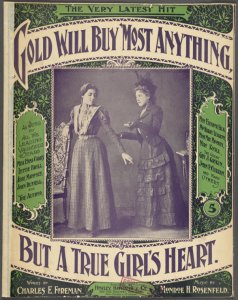
Gold will buy ’most anything b... Digital ID: 1255653. New York Public Library

It appears, according to an article in Miller-McClune, that the likelihood a woman will engage in a bit of over the top impulse spending depends a lot on the rhythms of her monthly "visitor."

The researchers, who are with the University of Hertfordshire, conducted a study of 443 women between the ages of 18 and 50, who were recruited through “an editorial piece in a popular monthly women’s magazine.” After providing information on the length of their menstrual cycle and their last menses, the women filled out a survey regarding their buying habits over the previous week.

Specifically, they rated on a 1-to-5 scale (from strongly agree to strongly disagree) such statements as “In the last seven days, my spending has been out of control,” and “I have bought something I am unlikely to wear or use.”

These reports were matched with where they were on their cycle during the week in question. (Forty-eight percent were premenstrual, 34 percent were menstrual or post-menstrual and 18 percent were mid-cycle).

“Spending was less controlled, more impulsive and more excessive for women … the further on they were in their cycle,” the researchers report. Strikingly, almost two-thirds of the premenstrual women reported they had bought something on impulse.


Thursday, June 3, 2010

Got To Be Good Looking 'Cos He's So Hard to See

Here is another entry from the "save money by not bargain hunting" file. Have you ever decided to feed your bargainista desire by getting together with a bunch of friends and piling in the car for the long drive to the outlet mall? It turns out they put those discount centers in the middle of nowhere for a sound psychological reason. The harder something is to attain, the more we value it. You could grab something out of the bargain bin at the store on the corner, but that is too easy, which makes it easy to avoid. When you go to all the trouble of driving to find bargains, you're much more likely to come back with something.

I learned about this through the blog Sociological Images, which has an article on the psychology of outlet malls:

...as Ellen Ruppel Shell explains in Cheap: The High Cost of Discount Culture. It turns out that being difficult to get to is, in fact, part of the appeal of outlet malls. The fact that they often require a drive of an hour or more signals to consumers that they must have really good deals. That’s the payoff for inconvenience — it’s harder and more time-consuming than going to your local mall, but in return you’re getting a great bargain...

According to Shell, though, that’s pretty typical of outlet malls: they often don’t really provide great bargains. But they provide the illusion of bargains, and a motivation for thinking you’re finding them...

It turns out that the more trouble people go through to get to an outlet, the more they overestimate the amount of savings compared to prices at regular stores. The very fact that it was hard to get to convinces people that it must provide something fantastic; if you aren’t saving a lot of money by going there, why on earth would it be so far out of the way? And the more remote it is, the cheaper the products must be!...

If you’ve driven an hour or more one-way to get great deals at the outlet mall, you are primed to believe you’re getting bargains because otherwise you just wasted a lot of time, effort, and gas for nothing. Once you get there, you’re psychologically motivated to believe your effort was worth it, and you do that by buying stuff and thinking the price is a steal...

We overestimate what the original value of the item must have been and focus on the difference between that hypothetical price and the outlet price, rather than on the objective price itself. And consumers tend to discount the cost of getting to the outlet, not including the cost of gas and their time into the price of the items they buy.


Marketers know us better than we know ourselves.

Tuesday, May 25, 2010

Handy Money-Saving Tip: Stop Bargain Hunting

"A bargain is something you can't use at a price you can't resist."-Franklin P. Jones*

In the past year or so magazines, newspapers and television programs have been full of features about how you can save money “in these difficult economic times.” (My retirement plan is to copyright the phrase “in these difficult economic times” and collect a royalty anytime a news announcer says it.)

Invariably these features tell you where to shop for the best prices. Rarely do they advise you not to shop. Not shopping, it turns out, is the only thing that is 100% guaranteed to save you money.

So if you want to really save money, here is my advice: stop bargain hunting. Don’t scour the coupon inserts, don’t “friend” your favorite brand to get a special discount feed, don’t rush to the store on double coupon day. All of these activities are simply giving you new ideas of things you could buy by exposing you to constant marketing messages and shiny new products. That’s what they’re designed to do.

You, of course, are too smart to be fooled and will only buy things you’d be buying anyway, right? Just like you never carry a balance on your credit card. Good for you!

But just on the off chance that you are not smarter than the rest of us, you’re probably better off keeping your hunter gatherer instincts in check by not exposing yourself to the hum of a constant shopping mantra. Let’s face it, the credit card companies would not be in business if we all did what we intended to do with their cards when we got them.

A number of studies have shown that we are prone to idealize the future. We are time, energy and money optimists. For some reason we all think we’ll be richer and less busy tomorrow than we are today.

We picture our work and the income from it as if nothing else will come up in our lives. We forget we’ll still have to fix the car, that there will be weddings and funerals and holidays (somehow those manage to surprise us every year, don’t they?) and your spouse or partner will still want attention. All that carefully budgeted time and money goes out the window when confronted with the shocking reality of every day life.

Since I wrote Broke is Beautiful, personal finance reporters have started to ask me for my money-saving tips. "How do you avoid impulse spending?" My flip answer is, “You max out your credit cards.” It’s a sure way to curb impulse spending. Although I say it with my tongue firmly in cheek, it is not entirely a joke.

When you have no access to funds, you simply cannot shop. After a while, you stop listening to commercial messages. They are for someone else-- those strange beings out there with money. It's a similar feeling to turning the radio dial and landing on a Spanish language radio station. “I can hear it, but it's not for me.”

The real trick is to get to this point before you max out your cards. Tell yourself “I don’t need new consumer goods right now, thank you very much. I have a thing right here in my house I can use.” (As all the news features about “decluttering” your home would suggest, most of us have more useable stuff than we know what to do with, yet we go shopping anyway.)

Stop categorizing yourself as a “consumer.” Imagine that there is a nation out there called Consumerica. The residents of this land are called “Consumers” and they communicate through commercials and branding messages. You don’t speak that language. Saving the entire price on an item is a bigger bargain than 50c off any day.


*Thank you to "Ultimate Cheapskate" Jeff Yeager for sharing this quote on Twitter (@JeffYeager)

Tuesday, October 13, 2009

Shopping is Bad for You

Here's one from the "Money is Dirty and Icky and You Wouldn't Want it Anyway" file.

Science News is reporting that your grocery receipt may covered in BPA, the estrogen-mimicking compound that is found in plastics and has been implicated in a variety of health problems in numerous recent studies. (It's the stuff that has made some people swear off plastic water bottles.)